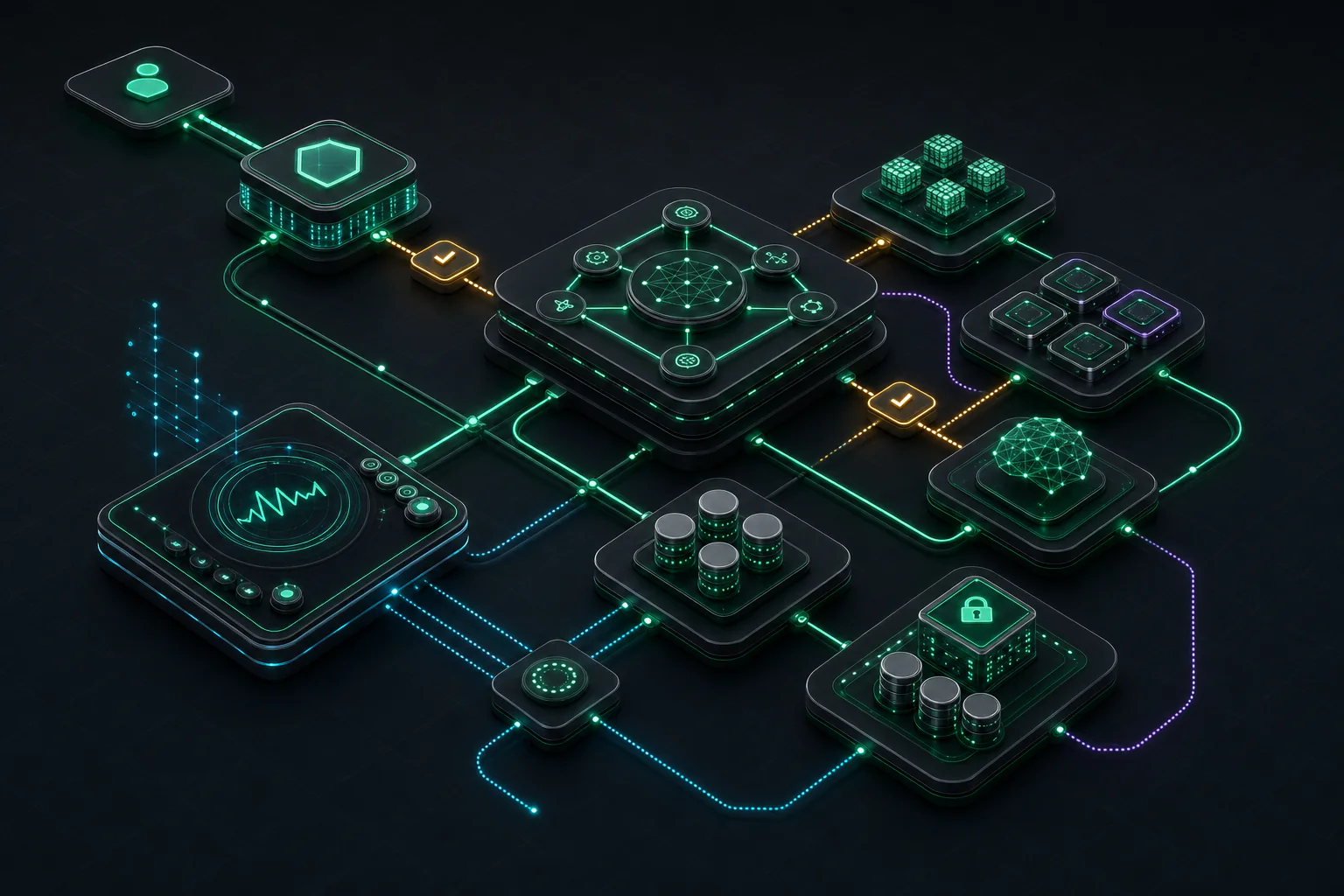
Operational trade-offs must be measured at the successful user outcome, inside the same security and quality boundary.
Model the whole unit
Include prompt and output tokens, cache behavior, retrieval, tools, retries, evaluation, storage, and operations. Segment by workflow because average cost hides expensive failure paths.
Measure experienced latency
Track queue time, time to first useful output, completion time, tool stages, and p95 or p99 behavior. Streaming changes perception but not completion cost. Shorter outputs and parallel independent work often provide direct gains.
Engineer bounded reliability
Use explicit timeouts, idempotency, retry budgets, circuit breakers, and fallbacks that preserve the original safety contract. Graceful degradation should expose reduced capability rather than invent certainty.
Optimize with routing and caching
Route tasks to the smallest validated model, escalate uncertainty, cache only when equivalence, tenant scope, policy version, and freshness are explicit, and invalidate on model or data change.
Keep security in the objective
A cheaper cache that crosses tenants or a faster tool path that bypasses authorization is not an optimization. Treat external content as untrusted, minimize data, and observe without indiscriminately recording sensitive prompts.
Decision checklist
- Name the user outcome and unacceptable failures.
- Identify the layer where the observed problem originates.
- Choose the smallest mechanism that directly addresses that problem.
- Define representative evaluation cases and operational budgets.
- Preserve source, model, prompt, data, and release versions.
- Require explicit approval before changing public behavior.
Continue Reading
All Blog PostsAutonomous Contract Redlining & Auditing in Enterprise M&A
How tier-1 corporate M&A teams deploy agentic LLM pipelines to analyze 10,000+ confidential deal documents under zero-data-retention VPC constraints and deterministic audit logging.
Autonomous Inventory Reconnaissance with Vision-Language Models
How enterprises are deploying VLMs on edge devices to automate warehouse cycle counting, demonstrating clear ROI and dealing with physical constraints.
Claude 3.5 Sonnet vs. GPT-4o: Enterprise Deployment Teardown
An architectural and operational teardown comparing Claude 3.5 Sonnet and GPT-4o across latency, prompt caching, structured output guarantees, and enterprise privacy.