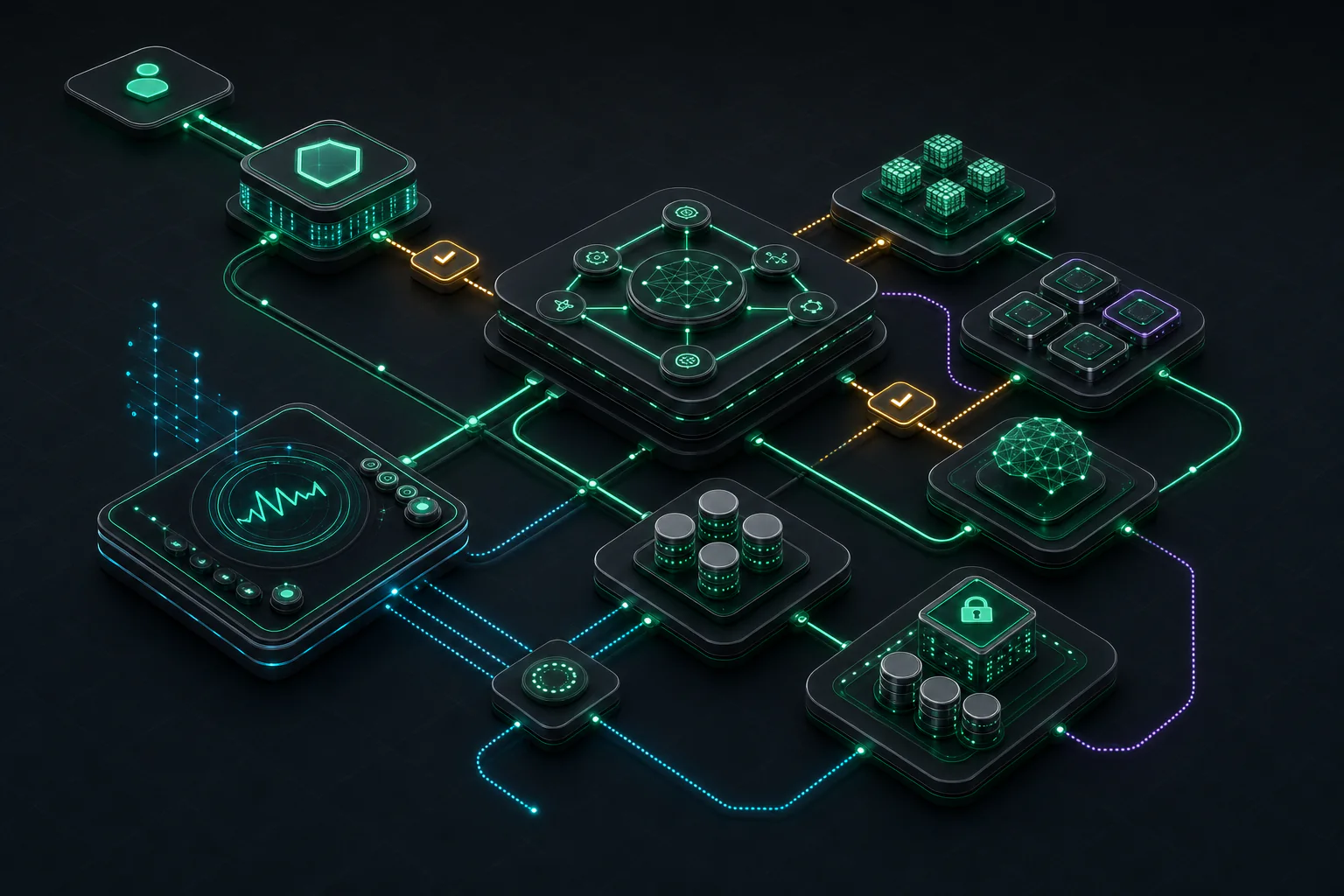
Architecture: The Enterprise Agent Interoperability Gap
Enterprise autonomous AI systems are frequently architected as monolithic silos: proprietary agent execution loops are tightly coupled with bespoke database connectors, file system APIs, and internal tools. This architectural coupling creates severe operational fragilities:
- Client Lock-In: User interfaces, evaluation harnesses, and workflow orchestrators cannot control agents uniformly across different frameworks (LangGraph, CrewAI, AutoGen, custom runtimes).
- Integration Explosion: Connecting $M$ distinct agent engines to $N$ enterprise data stores requires $M \times N$ ad-hoc integrations, each with separate authentication, serialization, and error-handling schemes.
- Control-Plane Fragility: Lack of standardized state persistence, step execution boundaries, and human-in-the-loop (HITL) checkpoints prevents safe enterprise deployment.
The modern production architecture resolves this fragmentation by establishing a clean separation between two complementary open standards:
- Agent Protocol: Defines the Northbound Control Plane—how external systems trigger, monitor, step through, pause, inspect, and terminate agent tasks over standard REST and Server-Sent Events (SSE).
- Model Context Protocol (MCP): Defines the Southbound Integration Plane—how the agent dynamically discovers, inspects, and executes tools, prompts, and resources exposed by decoupled, multi-server infrastructure via JSON-RPC 2.0.
The diagram above details the Agent Protocol lifecycle: tasks represent long-lived goals, executed through discrete, atomic steps that emit streaming thoughts, structured events, and persistent artifacts.
The complementary Southbound topology (shown above) federates heterogeneous MCP servers behind an intelligent router, mapping JSON-RPC capabilities into validated agent tool definitions.
1. Dual Protocol Specification & Architectural Comparison
Understanding where Agent Protocol ends and Model Context Protocol begins is essential for architecting enterprise control planes without redundant abstractions.
| Architectural Dimension | Agent Protocol (AI Engineer Foundation) | Model Context Protocol (Anthropic Open Standard) |
|---|---|---|
| Architectural Role | Northbound Agent Execution & Task Lifecycle Control Plane | Southbound Tool, Context & Data Resource Federation Plane |
| Primary Actors | Client App / Workflow Orchestrator $\longleftrightarrow$ Autonomous Agent | Agent Reasoning Core $\longleftrightarrow$ External Systems / Data Sources |
| Transport Layer | HTTP/1.1 REST (GET, POST) + Server-Sent Events (SSE) streaming | JSON-RPC 2.0 over stdio (local subprocess) or Streamable HTTP/SSE |
| Core Primitives | Task, Step, Artifact, StepResult | Tool (tools/call), Resource (resources/read), Prompt (prompts/get) |
| State Semantics | Statefully tracks multi-step task execution history and checkpointing | Sessions manage transport connection; tools and resources are typically idempotent |
| Human-in-the-Loop | Native step pause: is_last: false with client input requirement | Handled upstream in agent or via MCP prompt/sampling approvals |
| Artifact Management | Native /tasks/{task_id}/artifacts multipart upload and download | Out-of-band via file resources or base64 encoded tool outputs |
| Authentication | Bearer JWT / API Key at HTTP API Gateway ingress | mTLS, OAuth2 Bearer token, or OS process permission boundary |
2. Agent Protocol Specification & REST/SSE Runtime Lifecycle
Agent Protocol standardizes the execution boundary of autonomous agents into three hierarchical entities: Tasks, Steps, and Artifacts.
Core REST Endpoints
The Step Execution Loop
Rather than running a completely black-box infinite loop, Agent Protocol mandates an iterative step execution model. A client drives agent progress by invoking POST /tasks/{task_id}/steps:
When is_last: false, the agent indicates that further cognitive processing is required. The client (or automated orchestrator) immediately schedules the subsequent step until is_last: true signals goal achievement.
Real-Time Streaming via Server-Sent Events (SSE)
In production environments, synchronous HTTP step requests time out during deep agentic reasoning. Agent Protocol specifies SSE streaming on /tasks/{task_id}/steps/{step_id}/events or streaming task progress:
3. Model Context Protocol (MCP) Multi-Server Federation
While Agent Protocol manages the top-level task lifecycle, the agent needs a resilient, secure mechanism to interact with external tools and databases. The Model Context Protocol (MCP) provides a client-server architecture where the agent acts as an MCP Client connecting to multiple MCP Servers.
MCP Core Capabilities & JSON-RPC Framing
MCP communications use strict JSON-RPC 2.0 framing. An MCP Server advertises its capabilities during the initial initialize handshake:
LangChain MCP Adapters (langchain-mcp-adapters)
To bridge MCP servers into production agent frameworks (such as LangGraph or LangChain), systems use langchain-mcp-adapters. This library translates remote MCP tool definitions into standard LangChain BaseTool instances dynamically at runtime:
4. Unified Control Plane: The Agent Bridge Architecture
The centerpiece of enterprise deployment is the Agent Bridge Pattern. An Agent Protocol server hosts an internal stateful graph engine (e.g., LangGraph with Postgres checkpointer), connected downstream to an MCP Client Router.
Mapping Task ID to Thread Checkpointing
A primary requirement of enterprise agent resilience is that agent tasks must survive process restarts and node failures. In this architecture:
- Every incoming Agent Protocol
task_idis mapped directly to a LangGraphthread_id. - Every
POST /tasks/{task_id}/stepsloads the latest checkpoint from Postgres using thethread_id. - If the agent executes a destructive tool (e.g.,
drop_table,git_push_main), the graph triggers a Pregelinterrupt(). - The Agent Protocol step returns immediately with
is_last: falseand a metadata payload requiring human authorization:
The human operator inspects the proposed action in their management console and posts an approval step:
The agent graph resumes execution from the exact checkpoint, invokes the MCP database tool, and completes the task cleanly.
5. Multi-Server Connection Pooling & Resiliency Engineering
Production agents frequently invoke dozens of tools across multiple MCP servers. Managing these connections requires high-availability connection pooling:
Connection Pool Implementation Pattern
Decisions
| Decision | Required evidence | Review trigger | |---|---|---| | Use Agent Protocol (REST + SSE) as northbound agent control plane. | Requirement to integrate heterogeneous agent frameworks with standardized task lifecycles | Requirement to support third-party orchestrators | | Adopt Model Context Protocol (MCP) as southbound tool federation plane. | Multi-service integration requiring decoupled, dynamic tool discovery and sandboxing | Adding more than 5 distinct external data integrations | | Deploy hybrid MCP transport: stdio locally, Streamable HTTP/SSE for remote services. | Network and security audit requiring mTLS for cross-node calls and process isolation locally | Tool execution moving from local worker to distributed pod | | Persist agent checkpoints in PostgreSQL JSONPlus rather than ephemeral memory. | Audit compliance requiring deterministic replay and HITL state recovery | Deploying agents into regulated enterprise environments |
Alternatives and trade-offs
Custom WebSocket protocols provide low-latency duplex messaging but lack standardized schemas, locking client applications into specific agent frameworks. Hardcoding database tools directly into agent code minimizes network hops but creates tight coupling, security attack surfaces, and redeployment friction. Unifying Agent Protocol and MCP achieves modular, language-agnostic agent orchestration with standardized multi-server tool federation at the cost of managing dual protocol boundaries.
Failure modes
- Subprocess Zombie Leaks in
stdioTransports: If an Agent Protocol worker process is terminated abruptly, childstdioMCP server processes remain orphaned. Mitigate with POSIX process group supervision and automated EOF shutdown watchdogs. - Cascading JSON-RPC Request Timeouts: Long-running analytical database queries block the JSON-RPC transport loop, timing out subsequent tool calls. Mitigate with strict per-tool timeouts and asynchronous job ticket polling.
- Schema Drift Between Agent and MCP Tool Registry: An MCP server modifies parameter definitions while the agent uses cached schemas. Mitigate by subscribing to
notifications/tools/list_changedevents for dynamic re-binding. - Broken SSE Stream Reconnection in Agent Protocol: Transient network drops disconnect client SSE streams, triggering duplicate step executions. Mitigate by enforcing server-side idempotency keys on all step executions.
Operational checklist
- [ ] Protocol Compliance Audit: Verify Agent Protocol endpoints adhere strictly to the
/ap/v1/agent/*OpenAPI schema specification. - [ ] Transport Sandbox Isolation: Ensure
stdioMCP servers run with restricted non-root user permissions under Linux cgroups or Docker container constraints. - [ ] Mutual TLS (mTLS) Enforcement: Verify all remote MCP HTTP/SSE endpoints require valid client certificates and bearer token authorization.
- [ ] Connection Pool Watchdogs: Validate that MCP connection pools enforce 15-second heartbeat pings and reap unresponsive sessions within 30 seconds.
- [ ] Idempotency Gate Verification: Confirm that agent tool calls with side effects (financial transactions, email emissions, code merges) enforce unique idempotency tokens.
- [ ] Prometheus Alerting: Configure alerts for
agent_step_timeout_count(alert if $> 5$ in 5 min) andmcp_server_unhealthy_gauge(alert immediately if $> 0$).
Connected practice
- System breakdowns: /systems/inside-agent-protocol
- System breakdowns: /systems/inside-langchain-mcp-adapters
- System breakdowns: /systems/inside-deepagents
Sources
agent-protocol-repolangchain-mcp-adapters-repomcp-specification