
Executive Summary: Blockchain Systems & Decentralized AI Convergence
As autonomous AI agents acquire real-world agency, enterprise engineering architectures face a critical challenge: Trust Boundaries.
Un-constrained AI agents operating with raw private keys expose platforms to severe vulnerabilities—where a single prompt injection attack can drain funds or compromise critical infrastructure. At the same time, centralizing AI model weights and execution creates single points of failure, un-auditable outputs, and proprietary data lock-in.
The Blockchain, Verifiable Computation & Decentralized AI stack solves these issues by establishing:
- Cryptographic Proofs of Execution Integrity: Leveraging Zero-Knowledge Proofs (ZK-SNARKs/STARKs) and general-purpose RISC-V zkVMs to cryptographically verify that an AI model $M(X)=Y$ executed without weight tampering.
- Constrained Agent Runtime Pipelines: Utilizing Policy Engines and Programmable Smart Accounts (ERC-4337 / EIP-7702) to bound agent tool execution with strict contract allowlists, spending caps, and operator approval gates.
- Decentralized Data & Compute Infrastructures: Scaling GPU workloads across decentralized physical infrastructure networks (DePIN) and referencing immutable datasets via Content Identifiers (CIDs).
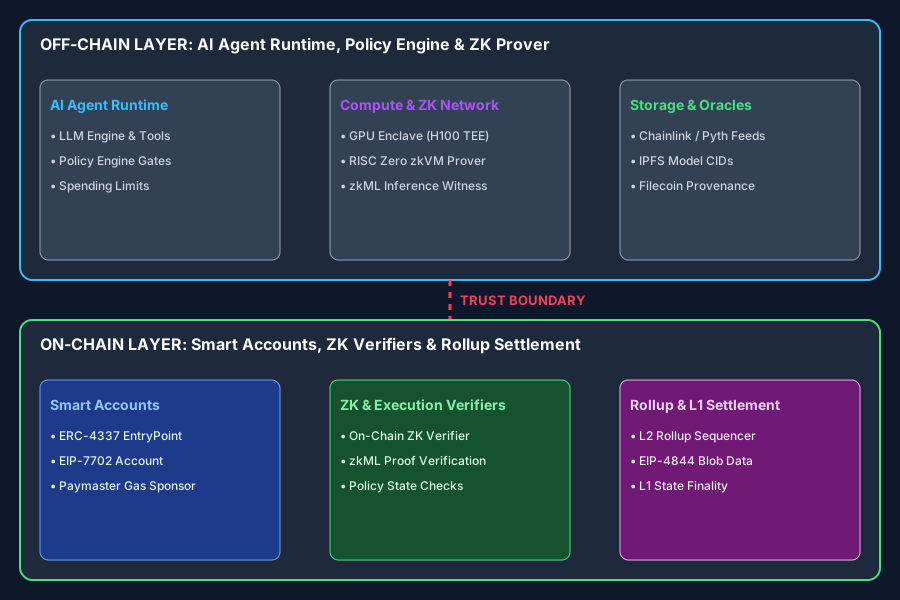
Architecture
The architecture spans two explicit tiers separated by a strict Trust Boundary:
1. Off-Chain Layer (AI Runtime, Compute & ZK Networks)
- AI Agent Runtime: LLM model engine generates tool calls intercepted by an off-chain Policy Engine.
- Decentralized GPU Compute (Akash / io.net / Render): Executes heavy fine-tuning and inference inside Hardware TEEs (NVIDIA H100 TEE / Intel SGX).
- zkVM Provers (RISC Zero / SP1): Compiles Rust/C++ computational execution into ZK-STARK receipts.
- Decentralized Storage (IPFS / Filecoin): References immutable model weights and vector index payloads via CIDs.
2. On-Chain Layer (Verification, Smart Accounts & Settlement)
- Account Abstraction (ERC-4337 / EIP-7702): Executes
UserOperationsviaEntryPointcontracts using scoped Session Keys.Paymasterssponsor gas fees. - ZK Verifier Contracts: Verifies zkML proofs on-chain before authorizing contract execution.
- Layer-2 Rollups & L1 Settlement: Posts batch data via EIP-4844 blobs to Ethereum L1 for global finality.
$$\text = \text(\pi, ; \text) \implies \text()$$
Decisions
- Decision 1: Never Entrust AI Agents with Raw Private Keys — Operate all agents through Account Abstraction smart accounts with strict Policy Engine gates and session keys.
- Decision 2: Distinguish Execution Integrity from Semantic Truth — Recognize that zkML verifies $M(X)=Y$ execution integrity, NOT real-world factual correctness.
- Decision 3: Prefer General-Purpose zkVMs Over Manual Circuits — Use RISC-V zkVMs (RISC Zero, SP1) to prove standard compiled software rather than hand-crafting domain-specific R1CS circuits.
- Decision 4: Enforce EIP-4844 Ephemeral Blobs for Rollup Data Availability — Utilize blobspace to reduce L2 batch submission costs by up to 90%.
Alternatives and trade-offs
| Architecture Option | Primary Best-For Case |
|---|
Failure modes
- Semantic Truth Fallacy: Assuming that because an AI inference has a valid zkML proof, the output is factually accurate in the real world.
- Un-Gated Agent Private Keys: Giving an AI agent direct EOA private key access without a Policy Engine or Smart Account boundaries.
- Flash Loan Oracle Exploits: Reading single-block AMM spot prices without TWAP windows or decentralized Chainlink feeds.
delegatecallProxy Hijacking: Executingdelegatecallto untrusted external logic contracts that overwrite storage slots.
Operational checklist
- [ ] AI Agent operates via ERC-4337 / EIP-7702 Smart Account with scoped session keys.
- [ ] Off-chain Policy Engine enforces contract allowlists, transaction spending limits, and operator approval thresholds.
- [ ] zkML inference receipts are verified on-chain by dedicated ZK verifier contracts.
- [ ] Large model artifacts and datasets are stored on IPFS/Filecoin and referenced via immutable CIDs.
- [ ] Static analysis (Slither) and invariant fuzz testing (Foundry) pass clean before deployment.
Sources
- Ethereum Improvement Proposals: EIP-4337 (Account Abstraction) & EIP-7702 (EOA Code Delegation)
- Ethereum Improvement Proposals: EIP-4844 (Proto-Danksharding)
- RISC Zero zkVM Architecture & Security Model Specifications
- W3C RDF & OWL Web Ontology Specifications
- Anthropic Trustworthy Agents & Effective Agent Architectures