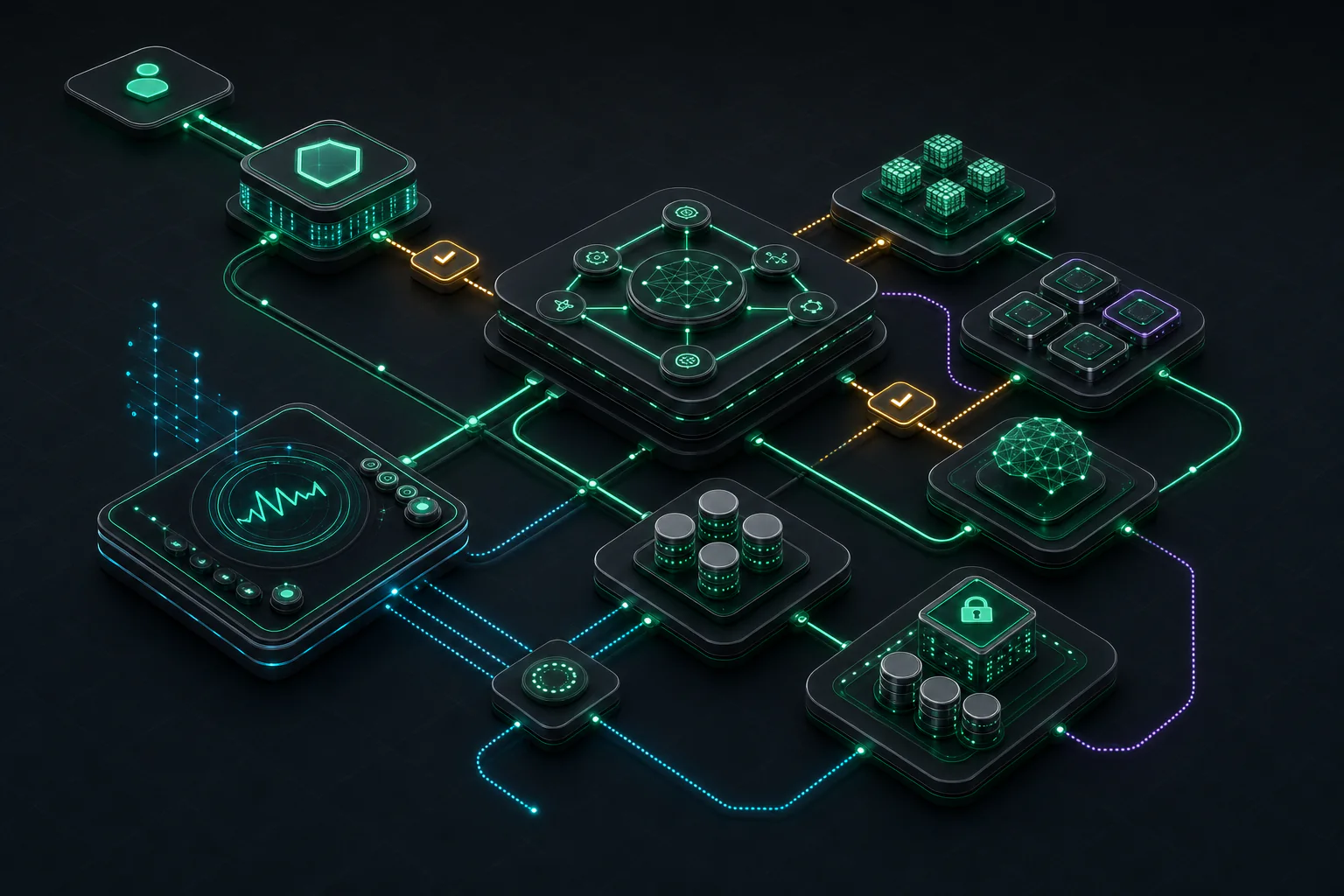
Architecture
Standard RAG struggles with multi-hop questions requiring global synthesis across an entire document corpus. GraphRAG connects extracted entities, relationships, and semantic communities into a structured knowledge graph to enable global summarization.
1. Mathematical Formulation: Hierarchical Community Detection & Modular Indexing
GraphRAG partitions extracted entity-relationship graphs into dense communities using the Leiden Algorithm to maximize graph modularity ($Q$):
Measures the density of entity connections inside sub-graph communities compared to random network distribution.
2. Architecture Comparison: Standard Vector RAG vs. Local GraphRAG vs. Global GraphRAG
| Architecture Option | Primary Best-For Case |
|---|
Decisions
| Decision | Required evidence | Review trigger | |---|---|---| | Use Leiden algorithm community detection for hierarchical graph partitioning. | Modular graph analysis showing non-overlapping dense sub-graphs | Graph partition modularity $Q < 0.3$ | | Pre-compute hierarchical community summaries at ingestion time. | Ingestion benchmark showing sub-second global query responses | Dataset-wide query response latency $> 2\text$ | | Combine local entity neighborhood graph traversals with global community maps. | Evaluation suite demonstrating 95%+ multi-hop accuracy | Failure on complex multi-entity query paths |
Alternatives and trade-offs
Standard vector RAG offers low ingestion cost and fast query response times but fails on broad dataset synthesis questions. Global GraphRAG solves dataset-wide summarization by pre-computing hierarchical community reports at the expense of higher initial ingestion LLM extraction costs.
Failure modes
- Entity extraction prompts generating duplicate node aliases (e.g. "vLLM" vs "vLLM Engine").
- Community detection algorithms creating overly sparse clusters on weakly connected graphs.
- Large community reports exceeding LLM context windows during global query map-reduce rounds.
Operational checklist
- [ ] Entity extraction prompt enforces entity canonicalization and deduplication.
- [ ] Leiden algorithm modularity threshold is tuned for optimal community sizes (15–50 nodes per cluster).
- [ ] Pre-computed community summaries are cached in vector storage for rapid global query routing.
- [ ] Graph database connection pool is configured with automatic retry policies for multi-hop traversals.
Connected practice
- Labs: /labs/rag-chunking-vector-search
- System breakdowns: /systems/inside-vllm
Sources
langgraph-repoanthropic-effective-agentsanthropic-trustworthy-agents