
Executive Summary: Why Ontologies Matter in Modern Tech
As systems grow in complexity across Software Microservices, Data Engineering Lakes, and Autonomous AI Agents, organizations face a recurring crisis: Semantic Drift.
Different teams define domain entities differently:
- Software Engineers model domain entities as TypeScript interfaces and Pydantic models.
- Data Engineers model tables as SQL DDL and Parquet column schemas.
- AI Engineers pass unstructured prompt context to probabilistic Large Language Models.
Without a unified semantic foundation, integration requires endless custom glue code, fragile ETL pipelines, and high rates of LLM hallucination.
An Ontology solves this problem by providing a machine-readable, mathematically grounded model of shared domain knowledge.
 Click to Zoom
Architecture
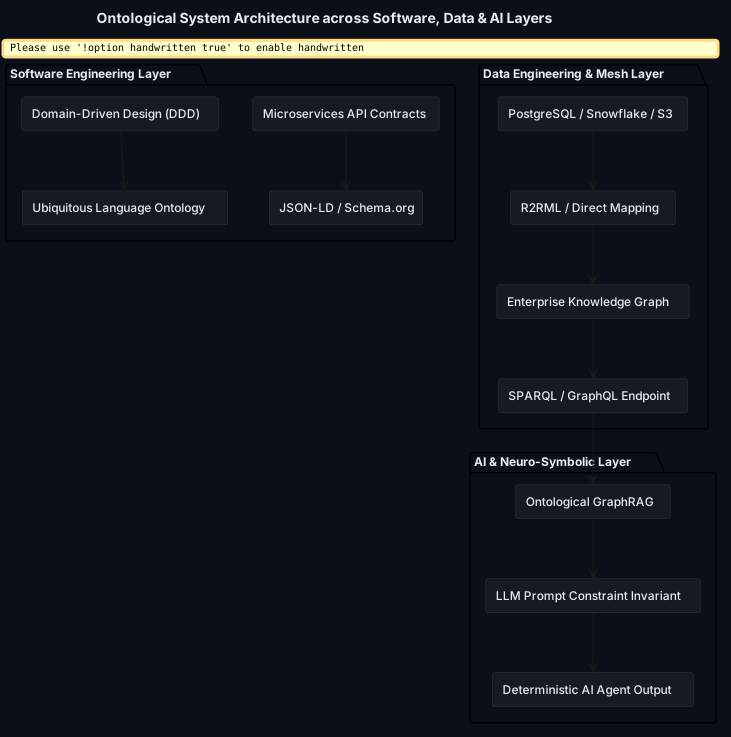
The ontology architecture spans three core engineering tiers:
- Software Engineering Layer: Domain-Driven Design (DDD) Bounded Contexts map directly to OWL classes, establishing an executable Ubiquitous Language.
- Data Engineering Layer: R2RML mapping rules virtualize physical PostgreSQL and Snowflake tables into a unified RDF Knowledge Graph accessible via SPARQL.
- AI & Neuro-Symbolic Layer: Ontological GraphRAG pipelines ground probabilistic LLMs with verified graph triples and OWL Description Logic constraints.
SPO Triple Representation
$$\text = \langle \text, ; \text, ; \text \rangle$$
turtle(15 lines)
1# Turtle (RDF) Example: Modeling AI Hardware & Model Competencies
2@prefix ex: <https://fullstackaihub.com/ontology/> .
3@prefix rdfs: <http://www.w3.org/2000/01/rdf-schema#> .
4@prefix owl: <http://www.w3.org/2002/07/owl#> .
5
6ex:HardwareAccelerator a owl:Class .
7ex:NVIDIA_GPU rdfs:subClassOf ex:HardwareAccelerator .
8
9ex:hasVRAMCapacity a owl:DatatypeProperty ;
10 rdfs:domain ex:HardwareAccelerator ;
11 rdfs:range xsd:integer .
12
13ex:NVIDIA_H100 a ex:NVIDIA_GPU ;
14 ex:hasVRAMCapacity 80 .
Decisions
- Decision 1: Adopt Open-World Assumption (OWA) for Cross-System Integration — Treat missing facts as UNKNOWN rather than FALSE to support distributed enterprise data discovery.
- Decision 2: Enforce SHACL Constraints in CI/CD — Validate RDF graphs against explicit structural shapes (
sh:NodeShape) before deploying new ontology releases. - Decision 3: Use Neuro-Symbolic GraphRAG for High-Stakes LLM Applications — Intercept LLM prompt generation with SPARQL graph queries to eliminate factual hallucinations.
Alternatives and trade-offs
Data & System Schema Modeling Comparison Matrix
| Architecture Option | Primary Best-For Case |
|---|
Failure modes
- Closed-World Assumption Contradiction: Expecting SPARQL queries over OWA graphs to behave like SQL
NOT EXISTSqueries. - Ontology Over-Engineering: Creating hundreds of abstract class hierarchies without concrete application query requirements.
- Unvalidated Graph Mutations: Ingesting un-vetted user RDF triples that trigger OWL Description Logic inconsistencies.
Operational checklist
- [ ] Core domain entities and relationships mapped to W3C RDF/OWL vocabularies.
- [ ] R2RML mappings configured for relational database virtualization over SPARQL endpoints.
- [ ] Automated SHACL shape validation suite integrated into CI/CD deployment pipelines.
- [ ] Ontological GraphRAG bounds LLM agent tool calling and prompt context retrieval.
Sources
- W3C RDF & OWL Web Ontology Language Specifications
- W3C SHACL (Shapes Constraint Language) Recommendation
- Anthropic Trustworthy Agents & Effective Agent Architectures