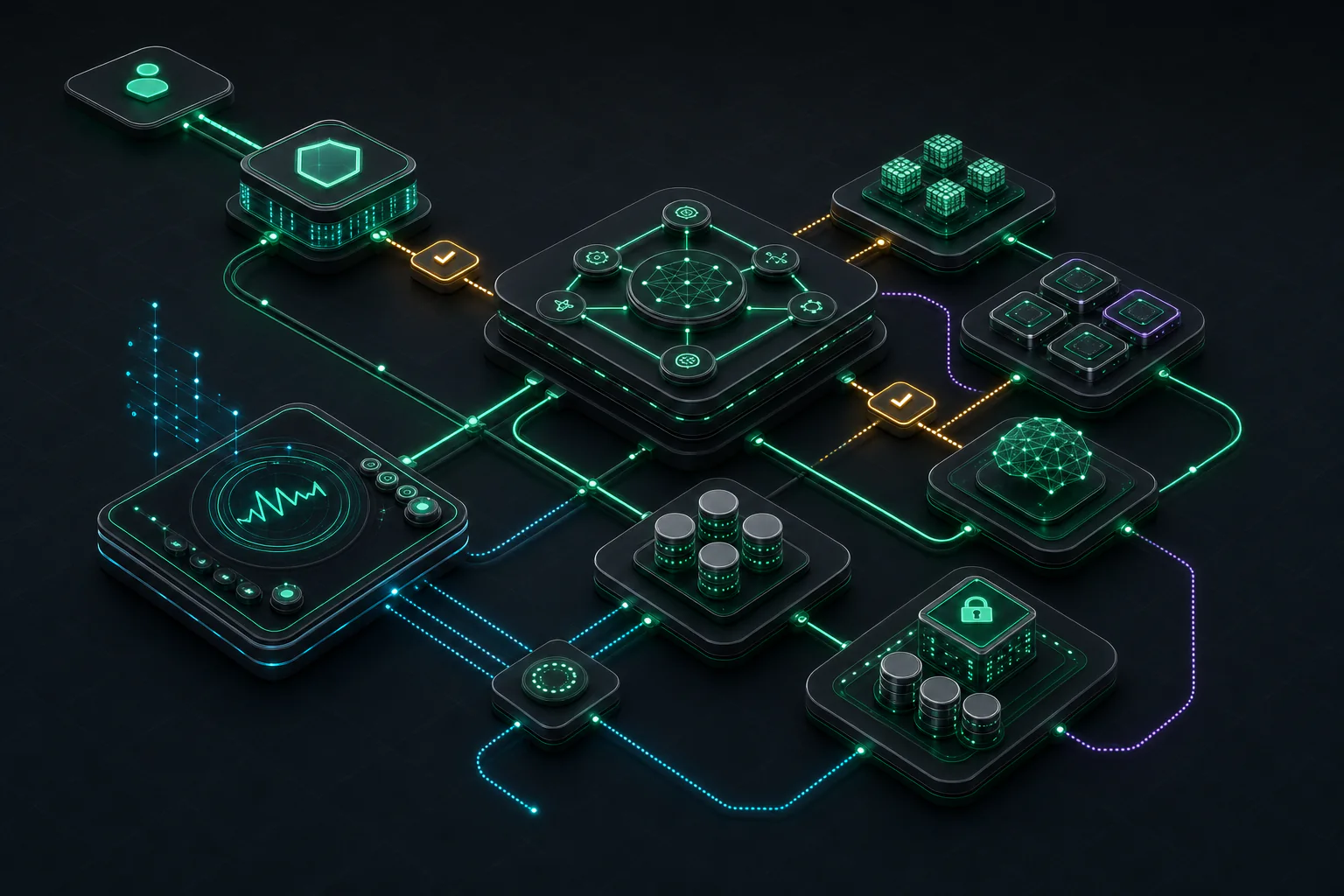
Architecture
An execution boundary for untrusted model proposals, typed validation, authorization, credentials, sandboxing, egress, approvals, and verification.
The architecture separates intent, policy, state, execution, evidence, and response. Each boundary has one accountable owner and an observable contract. Probabilistic components may propose or classify; deterministic software owns permissions, budgets, state transitions, and release conditions.
Decisions
| Decision | Required evidence | Review trigger | |---|---|---| | Treat model output and tool output as untrusted at different boundaries. | Versioned test, trace, or architecture record | Material workload, provider, policy, or data change | | Normalize and authorize exact parameters immediately before execution. | Versioned test, trace, or architecture record | Material workload, provider, policy, or data change | | Keep durable credentials outside model context. | Versioned test, trace, or architecture record | Material workload, provider, policy, or data change | | Verify effects through authoritative state, not tool prose. | Versioned test, trace, or architecture record | Material workload, provider, policy, or data change |
Alternatives and trade-offs
A centralized control plane simplifies policy and evidence collection but can become a latency and availability dependency. Distributed enforcement reduces central bottlenecks but requires consistent identity, versions, and audit semantics. Prefer the smallest boundary that can enforce the invariant and prove the outcome.
Failure modes
- Schema validation is mistaken for authorization.
- Containers mount host credentials or unrestricted networks.
- Approval tokens do not bind parameters.
- Tool output injects new instructions into the agent loop.
Operational checklist
- [ ] Unknown fields and ambiguous identifiers are rejected.
- [ ] Policy fails closed and carries tenant identity.
- [ ] Sandboxes restrict filesystem, process, network, and resources.
- [ ] Egress destinations and payloads are governed.
- [ ] Consequential actions have independent postcondition checks.
Connected practice
- Labs: /labs/prompt-injection-threat-model, /labs/agent-loop-tool-selection
- Projects: /projects/governed-agent-reliability
- System breakdowns: /systems/inside-openai-codex
Sources
owasp-llmmcp-specificationoauth-security-bcpnist-zero-trust