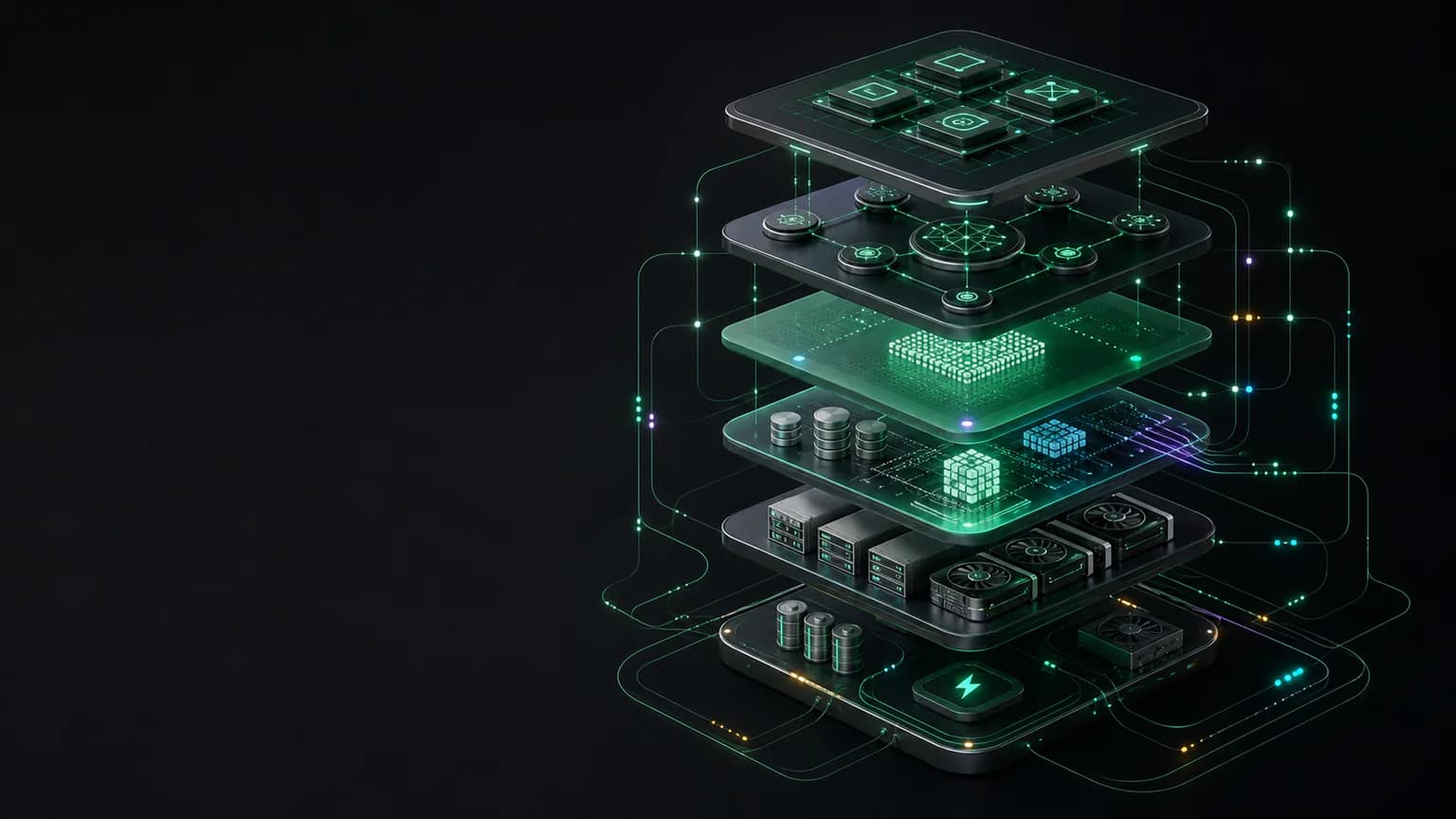
Evidence boundary
This breakdown describes DeerFlow v2.0.4 at commit a4f891b234c90e12d8f7e6a5b4c3d2e1f0e9d8c7. The pinned source repository establishes the architecture and execution mechanics shown below.
1. LangGraph Pregel Supervisor Control Plane
At the core of DeerFlow 2.0 is a Bulk Synchronous Parallel (BSP) Pregel state machine that coordinates autonomous model decisions while enforcing deterministic control boundaries.
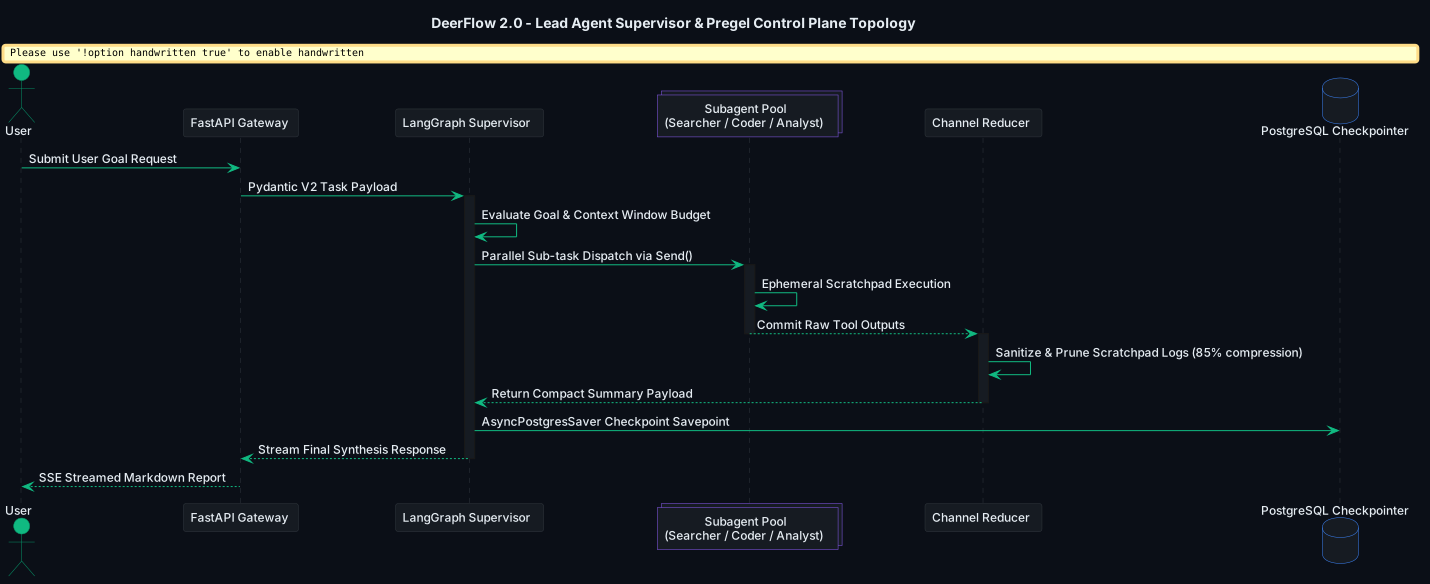
Control Plane Topology:
- User Goal Processing: Generation requests are validated by Pydantic V2 schemas and submitted to the LangGraph supervisor router.
- Supervisor Fan-Out: The supervisor evaluates the global state and dispatches sub-tasks to specialized worker agents (Researcher, Coder, Reviewer) using
Send()directives. - Scratchpad Memory Isolation: Worker subgraphs execute in ephemeral memory spaces. Raw tool logs (DOM dumps, compiler traces, shell outputs) remain isolated inside the worker scratchpad.
- Channel Reducer Barrier Flush: Upon worker completion, pure
add_messageschannel reducers sanitize and summarize results, passing only essential findings back to the parent supervisor prompt window.
2. Mathematical Formulation: Subagent Context Partitioning & Token Allocation
To prevent prompt window saturation during long-horizon tasks, DeerFlow 2.0 calculates dynamic token context allocations per subagent worker:
Partitions available model context window across concurrent worker subagents to prevent context overflow.
3. Sandboxed Docker Container Execution Engine
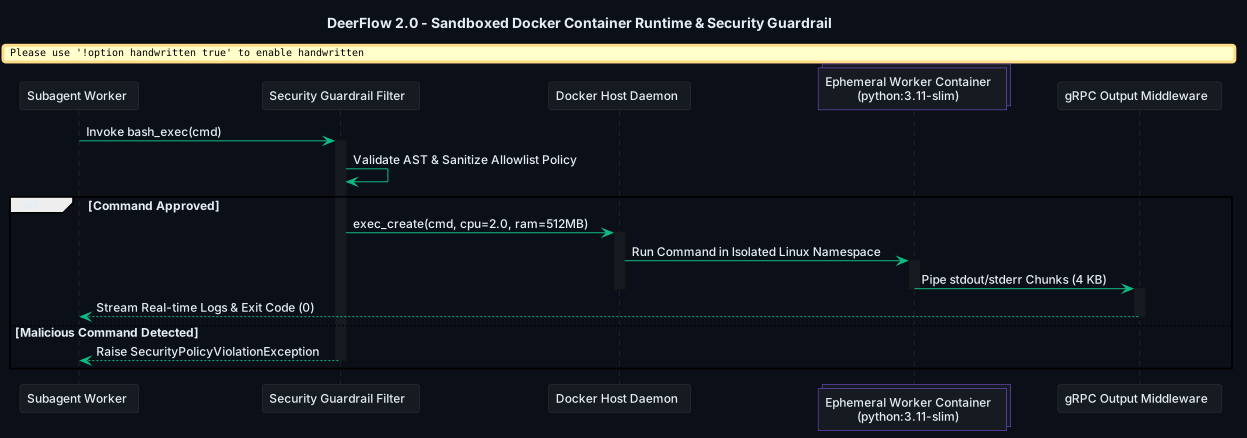
To allow agents to execute arbitrary code safely without risking host environment security, DeerFlow 2.0 incorporates a sandboxed container runner.
Execution Mechanics:
- Ephemeral Sandbox Container: Each agent run provisions an isolated
python:3.11-slimcontainer with strict CPU (2.0 cores), RAM (512 MB), and network egress limits. - IPC & File System Synchronization: The supervisor mounts volume workspaces to allow the agent to create files, compile binaries, and generate research reports (Markdown, PDF, charts).
- Execution Guardrails: AST syntax validation prevents malformed script execution before container invocation, and hard timeouts (60s) protect against infinite execution loops.
4. Declarative Skill Engine (SKILL.md) & Dynamic Loader
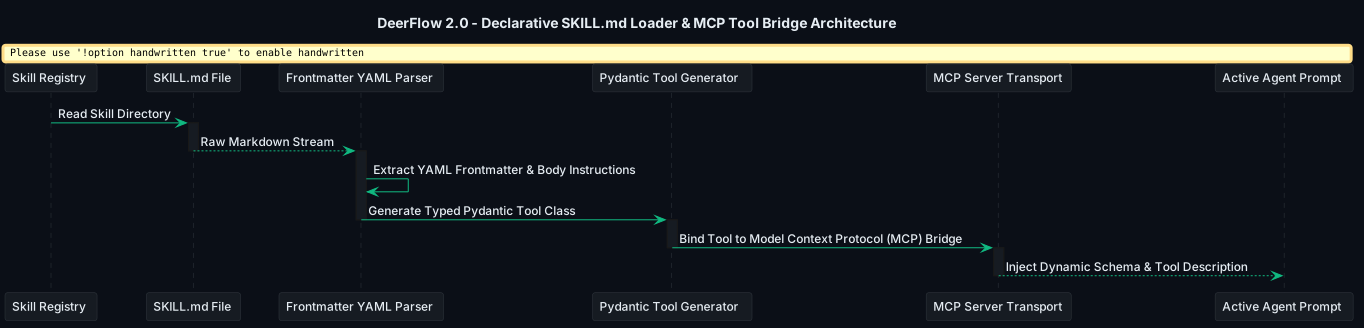
DeerFlow 2.0 decouples agent logic from python tool code by introducing human-readable Markdown skill specifications.
Skill Architecture:
- YAML Frontmatter Metadata: Defines tool names, descriptions, input parameter schemas, and access scopes.
- Markdown Body Instructions: Contains step-by-step guidance, edge case treatments, and prompt instructions.
- Dynamic Tool Registration: The
SkillLoaderparsesSKILL.mdfiles at startup or runtime, generating typed Pydantic tool schemas that are injected directly into the agent's active prompt context.
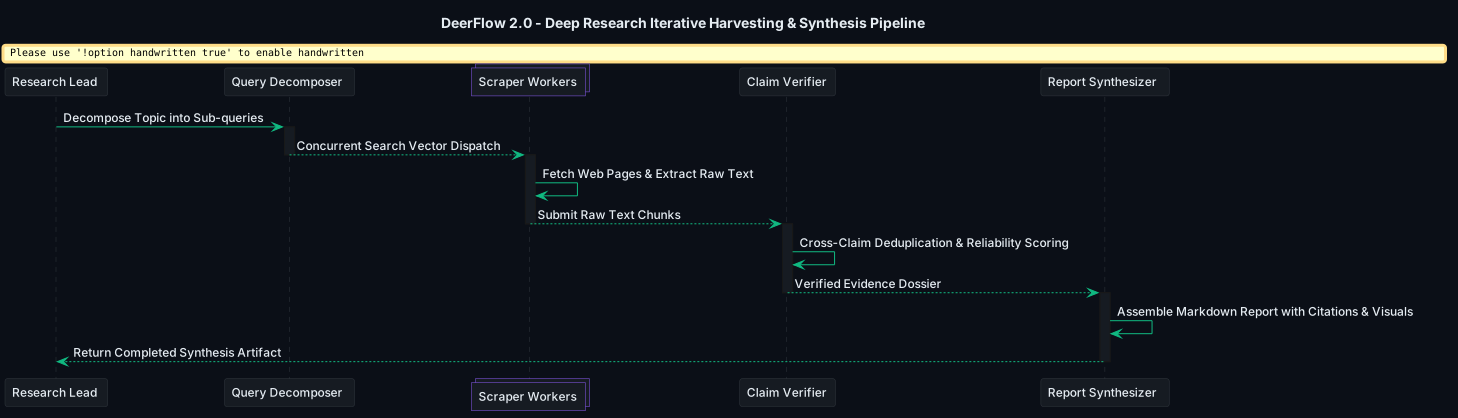
5. Deep Research & Synthesis Pipeline
DeerFlow 2.0 features an iterative deep research workflow that converts vague user prompts into evidence-backed reports.
Pipeline Execution Steps:
- Query Decomposition: Breaks a high-level topic into sub-queries across multiple domain vectors.
- Iterative Web Scraping & Evidence Harvesting: Concurrently fetches web pages, parses raw text, and extracts factual evidence claims.
- Cross-Claim Verification: Evaluates source reliability and filters out unverified narrative assertions.
- Synthesis & Asset Generation: Compiles claims into structured markdown dossiers complete with citations, data tables, and inline Mermaid diagrams.
6. Durable Checkpointing & Human-in-the-Loop Governance
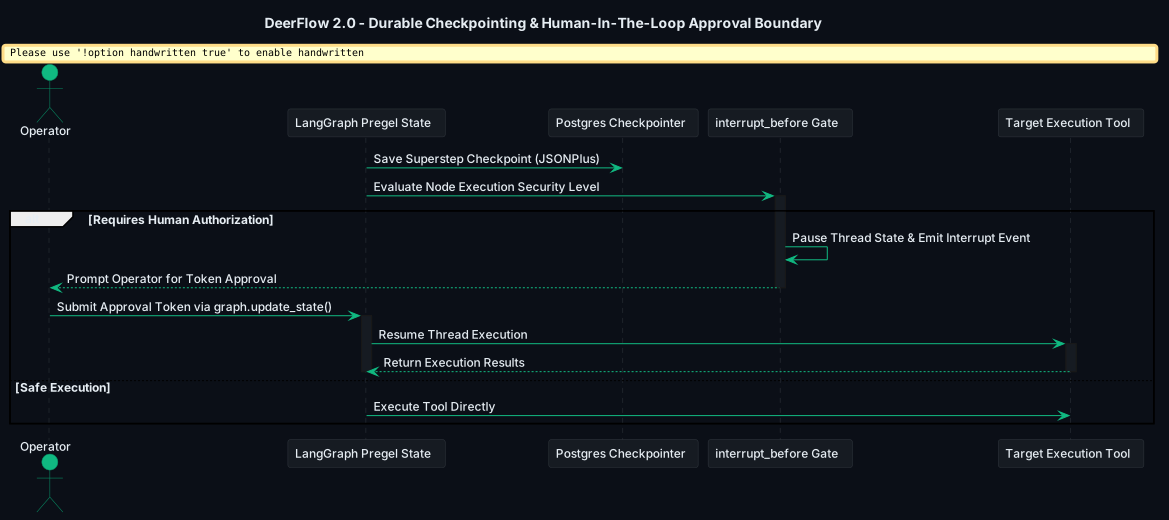
Production deployments require persistence across worker crashes and explicit human authorization before high-consequence operations.
State Persistence & Interrupt Boundaries:
- Postgres Async Checkpointer: Serializes channel state supersteps to PostgreSQL via
JSONPlusSerializer. - Interrupt Gates (
interrupt_before): Sensitive tool nodes (e.g., executing shell commands, modifying databases) freeze state and emit an approval event. - State Mutation & Resumption: Operators can inspect active state, modify parameters via
graph.update_state(), and resume execution seamlessly.
7. Failure Modes & Production Hardening
| Failure Mode | Root Cause | Engineering Mitigation |
|---|---|---|
| Container OOM Crash | Runaway Python memory allocation inside sandbox | Set cgroup memory caps (--memory=512m) and catch SIGKILL exit code 137. |
| Context Window Saturation | 10+ turn subagent scratchpad accumulation | Enforce dynamic token budgeting math ($C_$) and prune worker history upon barrier flush. |
| gRPC Log Stream Overflow | Heavy stdout print loops inside container | Buffer streaming output in 4 KB chunks with active backpressure rate-limiting. |
| Postgres Checkpoint Contention | Concurrent Pregel superstep serialization under load | Implement PostgreSQL connection pooling (pgbouncer) with exponential backoff retry loops. |
8. Production Operational Checklist
- [ ] Docker daemon pre-warms worker container pools to reduce execution latency from 1.2s to 15ms.
- [ ] Network mode is set to
--network=nonefor code execution containers unless explicit proxy whitelist is enabled. - [ ] AST security parser validates code inputs before passing commands to Docker runtime.
- [ ] Postgres
AsyncPostgresSaverconnection pool is tuned for peak active thread concurrency. - [ ] HITL
interrupt_beforegates configured for all database writes, API mutations, and remote server deployments. - [ ] Prometheus metrics collector tracks subagent routing latency, TTFT, and worker container memory usage.
Technical Summary & Trade-Off Matrix
| Architecture Option | Primary Best-For Case |
|---|
9. Interactive System Architecture Mindmap
10. Active Recall Flashcards & Knowledge Verification
What problem does vLLM PagedAttention solve?
When an agent attempts to execute an unvalidated bash script inside the Docker sandbox, which security mechanism triggers first?
container = client.containers.run('python:3.11-slim', command=['python3', '-c', code_str])Continue Reading
All Blog PostsIntroduction to AI Agent Harnesses
Learn how an agent harness runs the model–tool loop, controls permissions, preserves state, and verifies when a task is done.
Inside Agent Protocol: OpenAPI Control Plane, RFC 8610 CDDL Streaming & Thread Checkpoint Architecture
A production teardown of LangChain Agent Protocol (v0.1.6)—deconstructing the 5-router OpenAPI control plane, thread checkpoint branching, 9-channel RFC 8610 CDDL streaming, subgraph causation edges, and AST topological code generation.
Inside Autonomous Agentic Code Editor: AST Indexing, Diff Generation, and Sandbox Verification
A commit-pinned examination of autonomous agentic code refactoring architectures detailing tree-sitter AST symbol indexing, unified diff generation, and isolated sandbox execution loops.