Guided learning path
Model Serving and Inference
Understand inference engines memory scheduling batching routing scaling distributed execution lifecycle controls observability and economics.
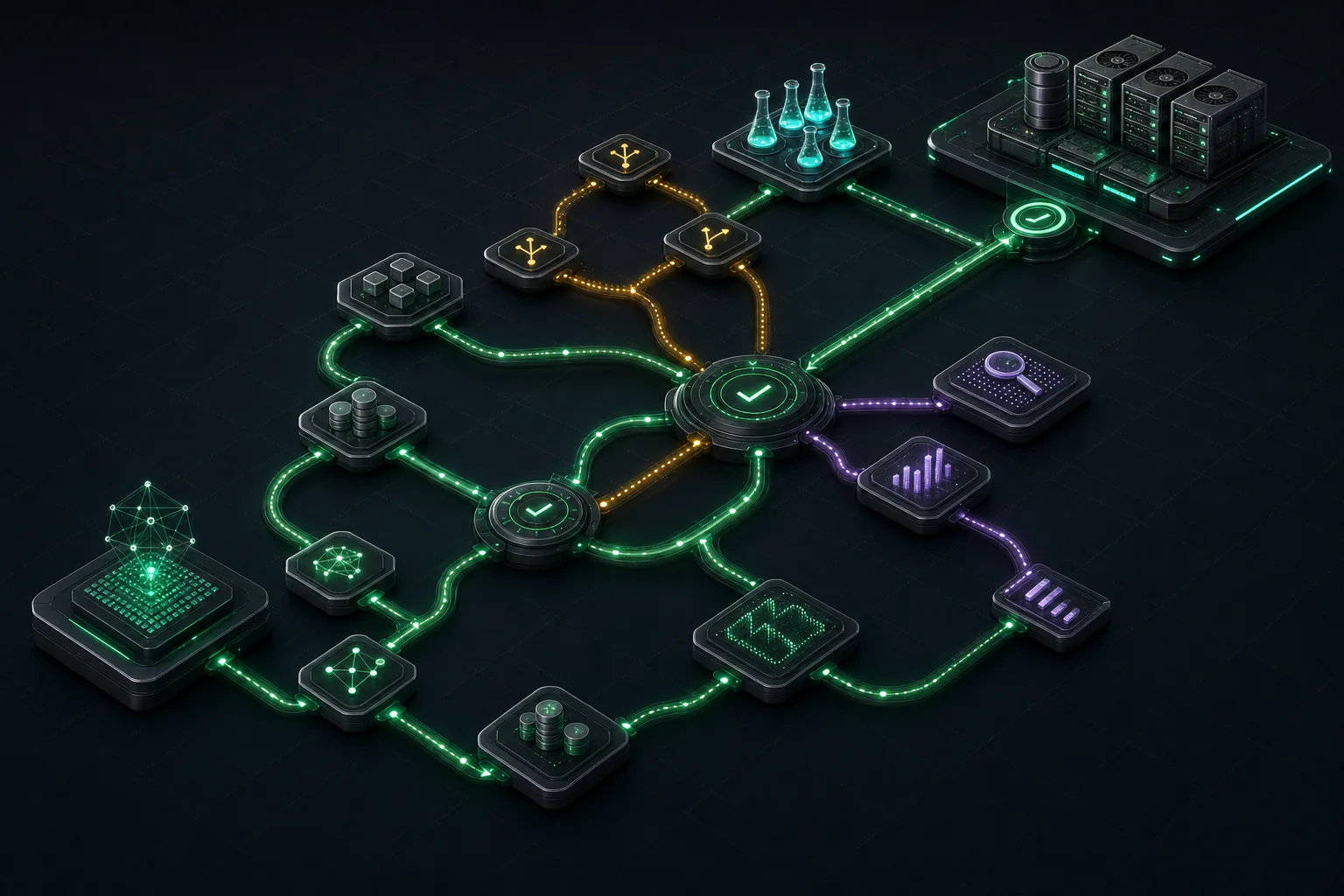
How model inputs become discrete identifiers and why token boundaries affect cost and meaning.
How attention feed-forward blocks residual paths and positions transform sequences.
How parameter learning differs from runtime generation and serving operations.
How finite input and output budgets constrain attention state relevance and cost.
How queueing prompt processing generation batching and concurrency determine serving performance.
Milestone: Inference mechanics
Connect model computation context and latency to runtime execution.
How schedulers KV-cache managers model runners and distributed executors determine serving behavior.
How routing batching caching autoscaling and accelerators serve model workloads.
How computation communication memory placement and failure domains shape large-scale AI platforms.
Milestone: Serving control plane
Explain engine scheduling serving routing scaling and distributed execution.
How versioned artifacts evaluation promotion monitoring rollback and retirement make model changes governable.
How correlated model retrieval tool and application spans expose system behavior.
How budgets fallbacks retries routing and service targets balance operating outcomes.
How per-task value quality compute tokens and operational costs determine viability.
Milestone: Lifecycle and economics
Operate versions traces reliability targets and cost per successful task.
How untrusted inputs sensitive data tools and external knowledge expand the threat model.
Translate workload distributions and service objectives into accelerator, memory, queue, and redundancy capacity.
Coordinate dynamic batches and admission limits to protect latency, memory, fairness, and throughput.
Choose replication, tensor, pipeline, data, or expert parallelism from model fit and service objectives.
Scale from demand and saturation signals while bounding queues, retries, and cold-start instability.
Define service objectives around successful, policy-compliant task outcomes as well as latency and availability.
Detect, contain, investigate, recover, and learn from quality, safety, data, tool, and provider incidents.
Milestone: Applied evidence
Demonstrate the path through current assessments, lab attempts, and project evidence.
Path outcomes
- Trace requests from routing and queues through model execution
- Diagnose cache batching parallelism and scaling bottlenecks
- Operate versioned serving systems with measurable reliability and cost