Guided learning path
RAG Engineer
Build evidence-carrying retrieval systems from ingestion and provenance through search reranking grounded generation and evaluation.
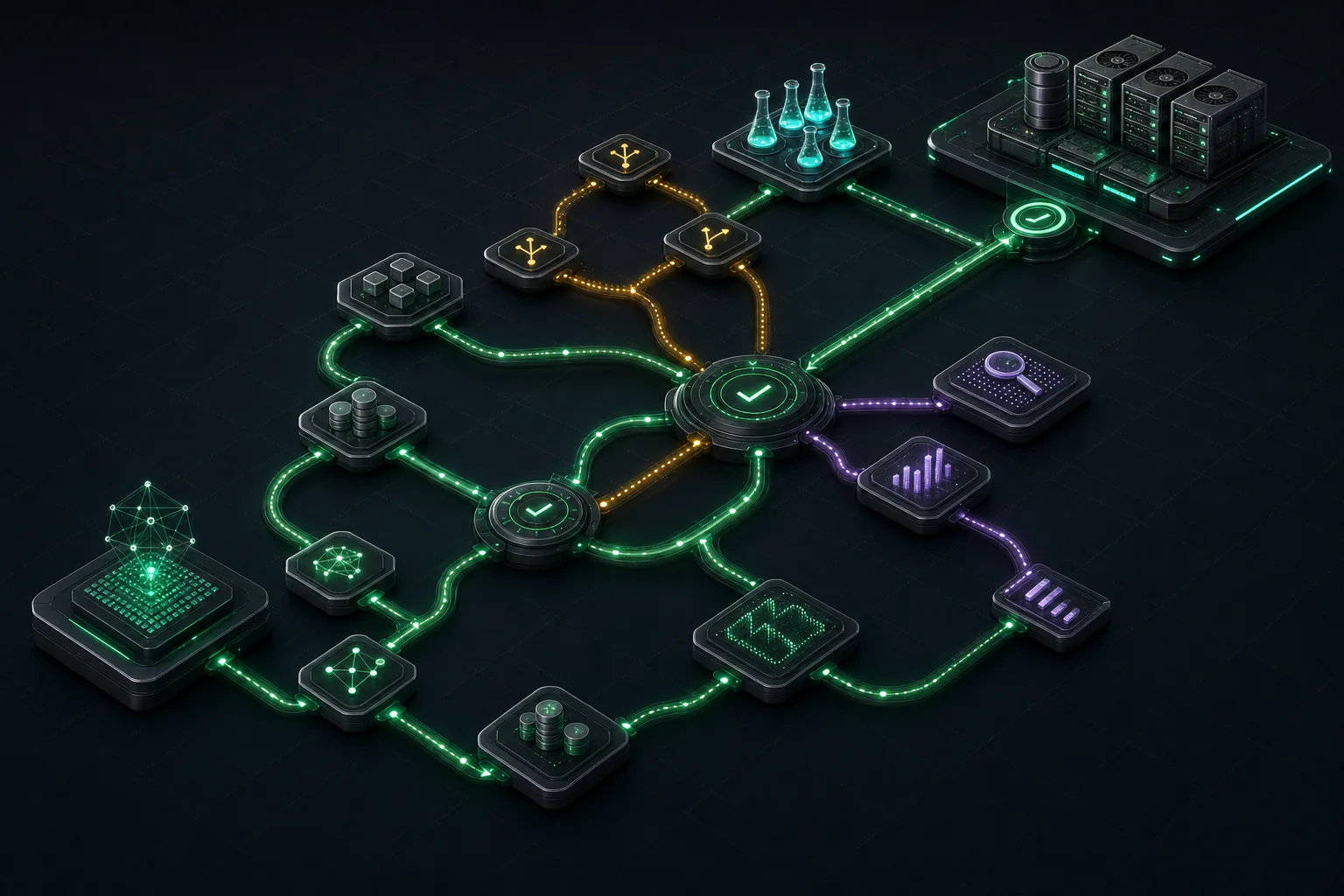
How model inputs become discrete identifiers and why token boundaries affect cost and meaning.
How learned vectors encode useful similarity and support representation and retrieval.
How finite input and output budgets constrain attention state relevance and cost.
How systems select assemble order compress and isolate information for each model call.
How knowledge access behavior adaptation and tool use solve different system problems.
How parsing normalization segmentation metadata and updates create retrievable units.
How embeddings similarity indexes filters and recall tradeoffs retrieve semantic candidates.
Milestone: Representation and retrieval
Build the embedding chunk and candidate-retrieval mental model.
How lexical semantic and learned ranking stages improve candidate precision and recall.
How origin ownership version and transformation metadata make knowledge auditable.
How answer synthesis constrains claims to evidence and preserves inspectable attribution.
Milestone: Evidence pipeline
Combine reranking provenance and grounded synthesis into an inspectable flow.
How task definitions datasets metrics rubrics judges and experiments measure system quality.
How unsupported claims arise and how evidence constraints and verification reduce them.
How correlated model retrieval tool and application spans expose system behavior.
How untrusted inputs sensitive data tools and external knowledge expand the threat model.
How budgets fallbacks retries routing and service targets balance operating outcomes.
Milestone: RAG operations
Evaluate trace secure and operate the retrieval system under real constraints.
Measure whether retrieval finds sufficient, relevant, authorized, and fresh evidence before grading generation.
Operate ingestion, versioning, freshness, deletion, rebuild, rollback, and reconciliation as one index lifecycle.
Enforce tenant and document authorization before evidence enters ranking or model context.
Transform and route queries while preserving user intent, policy context, and evaluation traceability.
Preserve tenant boundaries across retrieval, prompts, caches, tools, telemetry, evaluation, and support operations.
Make retention and deletion propagate through derived indexes, caches, traces, evaluations, and backups with auditable evidence.
Milestone: Applied evidence
Demonstrate the path through current assessments, lab attempts, and project evidence.
Path outcomes
- Design corpus-specific ingestion retrieval and reranking experiments
- Preserve provenance access controls and inspectable citations
- Diagnose retrieval generation and grounding failures separately