Guided learning path
LLM Systems Foundations
Build a connected mental model from tokens through retrieval evaluation security and operations.
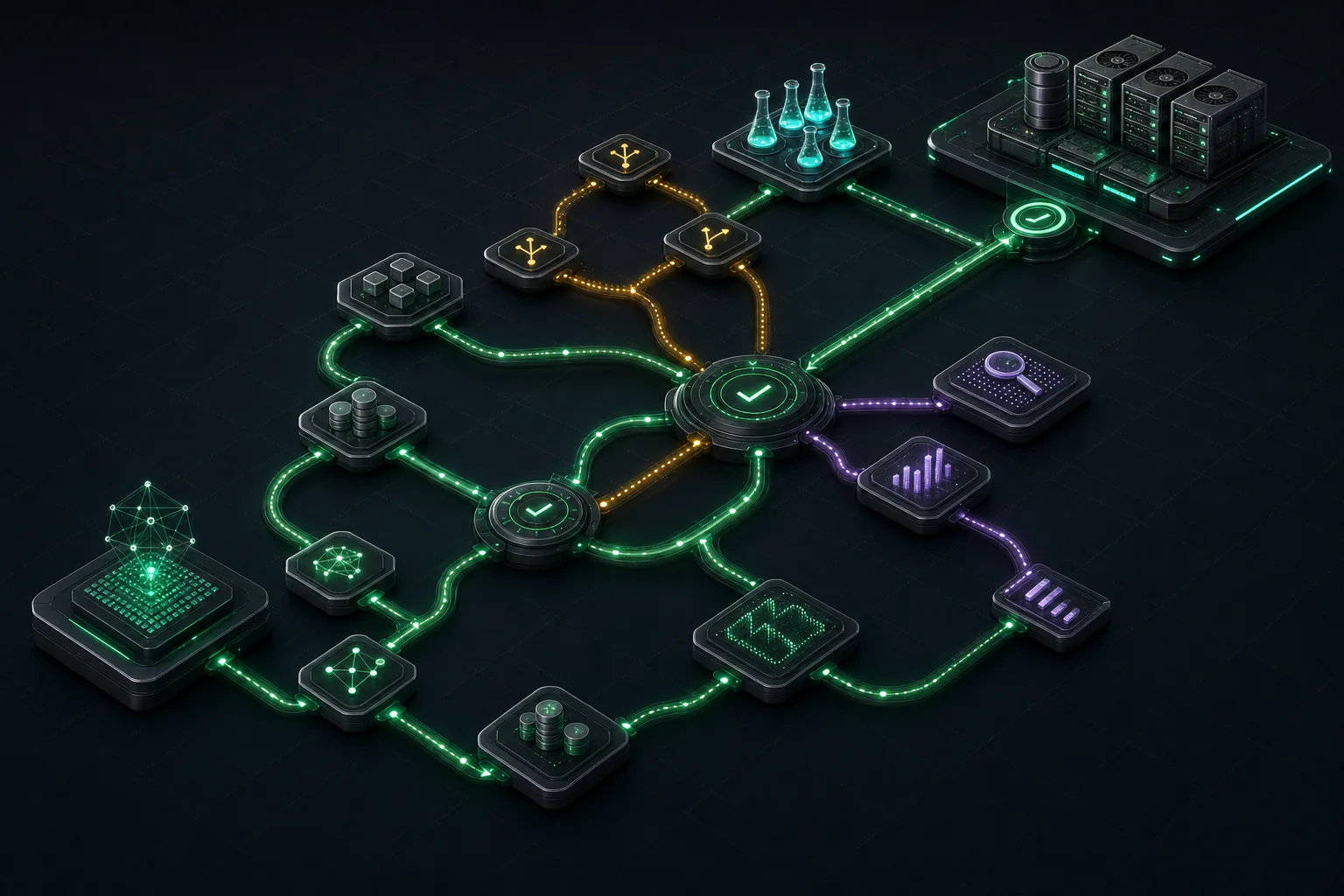
How model inputs become discrete identifiers and why token boundaries affect cost and meaning.
How learned vectors encode useful similarity and support representation and retrieval.
How attention feed-forward blocks residual paths and positions transform sequences.
How parameter learning differs from runtime generation and serving operations.
How finite input and output budgets constrain attention state relevance and cost.
How logits temperature top-p and deterministic choices shape generated sequences.
How capability modality size versioning deprecation and routing affect model selection.
How queueing prompt processing generation batching and concurrency determine serving performance.
Milestone: Model foundations
Explain the model computation and inference controls beneath an application.
How instruction sources and ordered messages establish conversational control context.
How clear goals constraints context examples and output contracts guide model behavior.
How schemas convert probabilistic text generation into validated application contracts.
How models propose typed actions while applications retain execution authority and validation.
How systems select assemble order compress and isolate information for each model call.
How applications persist working state history summaries facts and user-controlled records.
How reusable computations reduce latency and cost while introducing freshness and correctness risks.
How knowledge access behavior adaptation and tool use solve different system problems.
Milestone: Application control
Build explicit prompt output tool context state and adaptation boundaries.
How parsing normalization segmentation metadata and updates create retrievable units.
How embeddings similarity indexes filters and recall tradeoffs retrieve semantic candidates.
How lexical semantic and learned ranking stages improve candidate precision and recall.
How answer synthesis constrains claims to evidence and preserves inspectable attribution.
How task definitions datasets metrics rubrics judges and experiments measure system quality.
How unsupported claims arise and how evidence constraints and verification reduce them.
How budgets fallbacks retries routing and service targets balance operating outcomes.
How untrusted inputs sensitive data tools and external knowledge expand the threat model.
Milestone: Production readiness
Connect retrieval evaluation security reliability and economic constraints.
Required labs
Required projects
Path outcomes
- Explain the complete anatomy of an LLM application
- Select context retrieval tool and adaptation strategies
- Design measurable secure and economically viable systems