Guided learning path
Agentic Systems Engineer
Engineer bounded tool-using systems with explicit workflows state protocols evaluation observability security and human control.
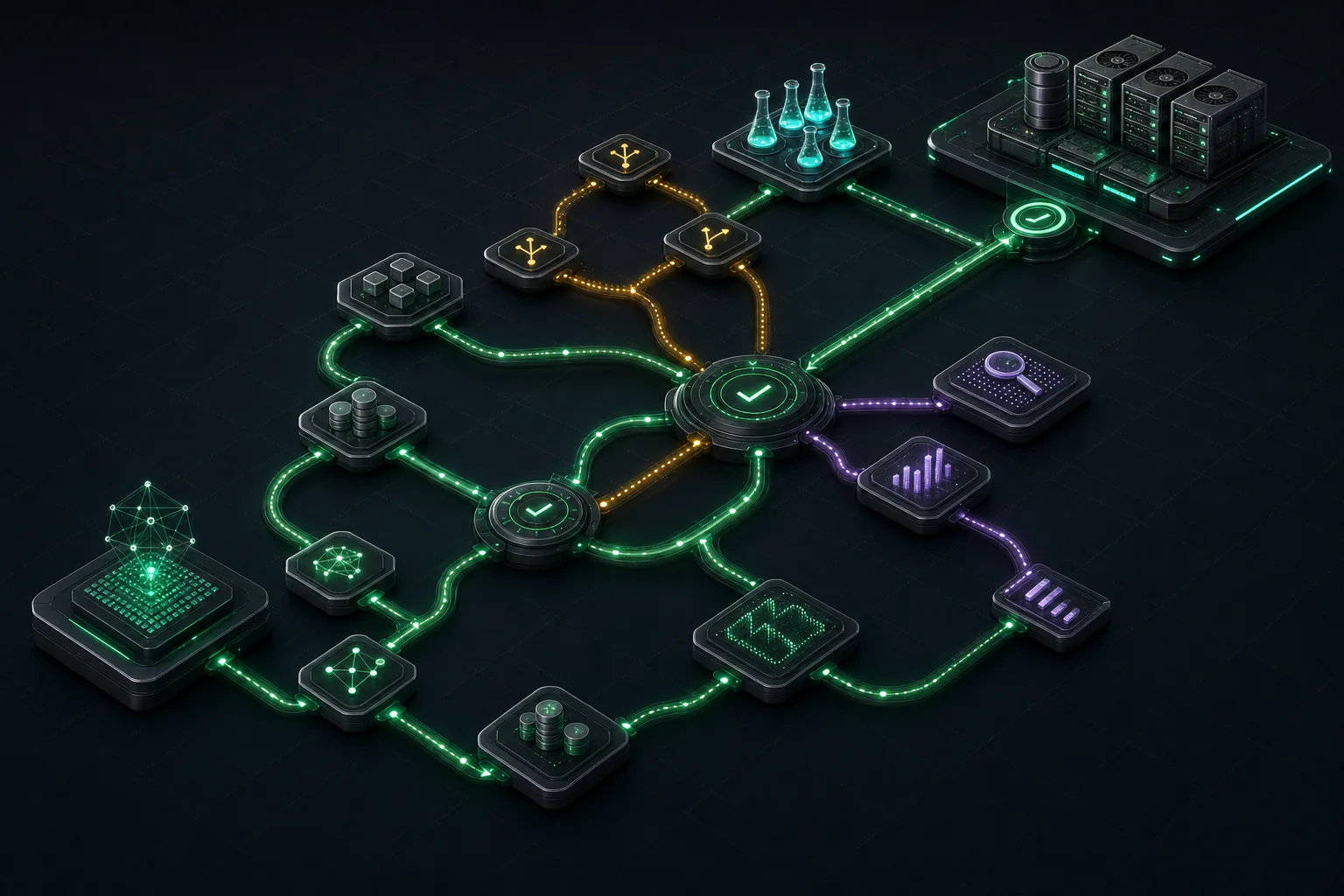
How instruction sources and ordered messages establish conversational control context.
How clear goals constraints context examples and output contracts guide model behavior.
How schemas convert probabilistic text generation into validated application contracts.
How models propose typed actions while applications retain execution authority and validation.
How systems select assemble order compress and isolate information for each model call.
How applications persist working state history summaries facts and user-controlled records.
How explicit state transitions coordinate repeatable AI and software work.
Milestone: Agent building blocks
Establish tool context state and workflow contracts before autonomy.
How standardized discovery invocation and data exchange connect model systems.
How bounded observe decide act and verify cycles produce controlled autonomy.
How consequence and reversibility determine when human authorization is mandatory.
How interfaces expose progress uncertainty evidence and correction controls.
Designing UI states for tool callbacks: loading skeletons, success parameters, and execution progress bars.
Milestone: Bounded autonomy
Connect control loops protocols approvals and visible execution state.
How task definitions datasets metrics rubrics judges and experiments measure system quality.
How to combine deterministic software tests model evaluations adversarial checks and monitored production evidence.
How correlated model retrieval tool and application spans expose system behavior.
How untrusted inputs sensitive data tools and external knowledge expand the threat model.
How adversarial tests policy checks monitoring and response control harmful behavior.
How ownership classification documentation and review control lifecycle risk.
Milestone: Trustworthy operation
Test trace secure and govern the complete agent control path.
Evaluate agent trajectories, actions, outcomes, and policy compliance rather than judging only the final response.
Design retries, compensation, escalation, and safe termination around typed agent failure states.
Persist resumable agent state with explicit versions, side-effect boundaries, and replay semantics.
Bound agent time, tokens, tools, cost, risk, and loop depth with explicit stop reasons.
Verify intended and actual effects independently before an agent can declare success.
Authorize each proposed tool action against identity, scope, resource, parameters, and consequence at execution time.
Use short-lived, audience-bound, least-privilege credentials without exposing secrets to model context.
Constrain tool execution with filesystem, process, network, resource, and data-exfiltration boundaries.
Validate typed tool arguments before execution and treat tool output as untrusted data afterward.
Milestone: Applied evidence
Demonstrate the path through current assessments, lab attempts, and project evidence.
Path outcomes
- Choose between deterministic workflows and autonomous loops
- Design typed tools bounded state stopping conditions and approvals
- Evaluate multi-step outcomes traces and safety failure modes