Guided learning path
AI Evaluation and Reliability
Turn product intent and risk into representative evaluations release gates traces service targets and continuously improving regression evidence.
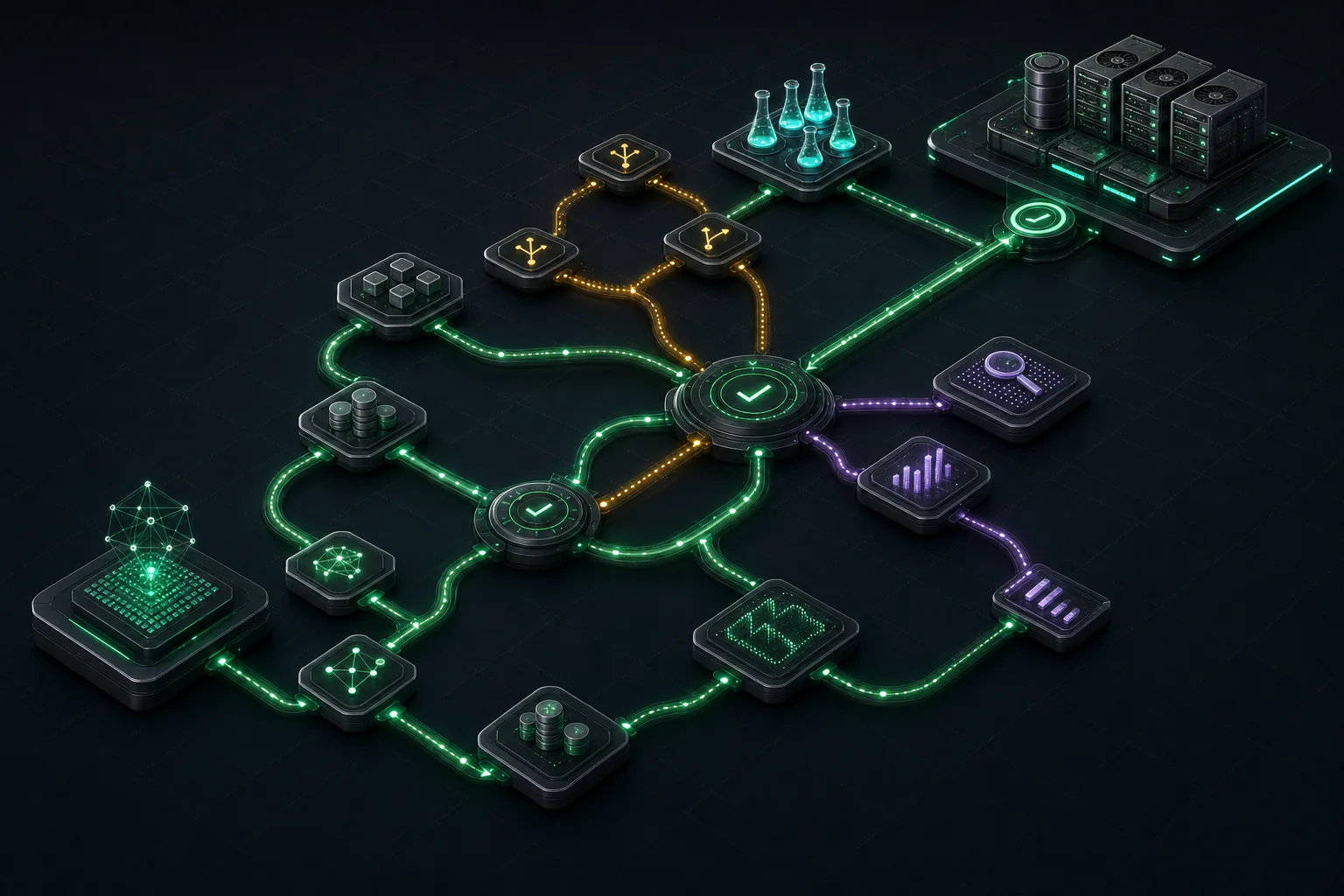
How uncertain model capabilities map to valuable testable user outcomes.
How primary sources experiments and explicit confidence create durable knowledge.
How task definitions datasets metrics rubrics judges and experiments measure system quality.
Milestone: Measurable outcomes
Translate capability claims into cases metrics rubrics and slices.
How unsupported claims arise and how evidence constraints and verification reduce them.
How to combine deterministic software tests model evaluations adversarial checks and monitored production evidence.
How correlated model retrieval tool and application spans expose system behavior.
How adversarial tests policy checks monitoring and response control harmful behavior.
Milestone: Layered assurance
Combine system tests grounding checks traces and adversarial evaluation.
How budgets fallbacks retries routing and service targets balance operating outcomes.
How per-task value quality compute tokens and operational costs determine viability.
How ownership classification documentation and review control lifecycle risk.
Milestone: Reliability control
Connect operational targets economics and governance to release decisions.
Evaluate agent trajectories, actions, outcomes, and policy compliance rather than judging only the final response.
Verify intended and actual effects independently before an agent can declare success.
Measure whether retrieval finds sufficient, relevant, authorized, and fresh evidence before grading generation.
Define service objectives around successful, policy-compliant task outcomes as well as latency and availability.
Detect, contain, investigate, recover, and learn from quality, safety, data, tool, and provider incidents.
Detect behavior changes across model, prompt, retrieval, tool, policy, and grader versions.
Run staged experiments that test model capability, workflow value, operational fit, and risk before scaling.
Milestone: Applied evidence
Demonstrate the path through current assessments, lab attempts, and project evidence.
Path outcomes
- Build evaluation suites around decisions risks and operating conditions
- Combine deterministic model human adversarial and production evidence
- Use traces incidents and service targets as a reliability control loop